LVarsin mielenkiintoinen tutkimus sakemanneilta. Tutkimus alleviivaa - ehkä hieman tarkoitushakuisesti eurooppalaisten valmistajien kilpailuetua, hyötysuhdetta. Hyötysuhdetta kuvaamaan on kehitettuy indeksi, SPI.
The researchers attested 10 systems to the highest efficiency class A. The evaluation results confirm the outstanding system efficiency, especially for European inverter manufacturers. In addition to the European suppliers, only the Chinese manufacturers GoodWe and Fox ESS are represented among the leaders this year. With the new H3-10.0-Smart hybrid inverter and ECS2900-H6 battery, Fox ESS achieves a very good SPI (10 kW) of 94.8%. The new and high-performance hybrid inverters PLENTICORE G3 M 10 from KOSTAL and Symo GEN24 12.0 Plus SC from Fronius perform even slightly better in combination with a high-voltage battery from BYD. Both systems can charge and discharge the Premium HVS 12.8 battery box with more than 10 kW and are suitable for larger PV systems. New to the test are eight devices, including from Fox ESS, Fronius, Kostal and SAX Power. The HTW researchers were surprised that two companies decided to participate in the study anonymously despite very good efficiency results.
Lähde: solar.htw-berlin.de
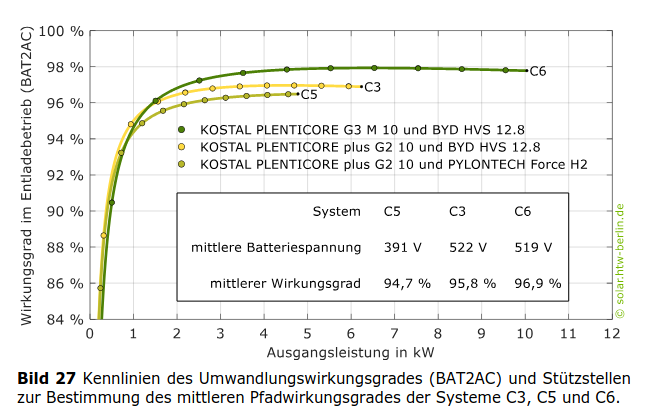
Kuva 27
Hyötysuhde BAT--> AC... hyötysuhde jää 90% pintaan alle 1kW teholla (10% nimellistehosta).
"Characteristic curves of the conversion efficiency (BAT2AC) and interpolation points
for determining the average path efficiency of systems C3, C5 and C6" (kone käännös Saksasta)
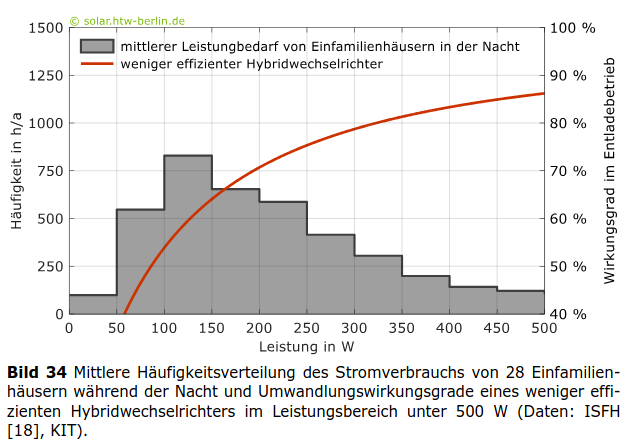
Kuva 34
Hyötysuhde keskimääräisen kulutuksen mukaan, saksa yhden henkilön talous.
"Average frequency distribution of the electricity consumption of 28 single-family houses during the night and conversion efficiencies of a less effi efficient hybrid inverter in the power range below 500 W" (kone käännös Saksasta)
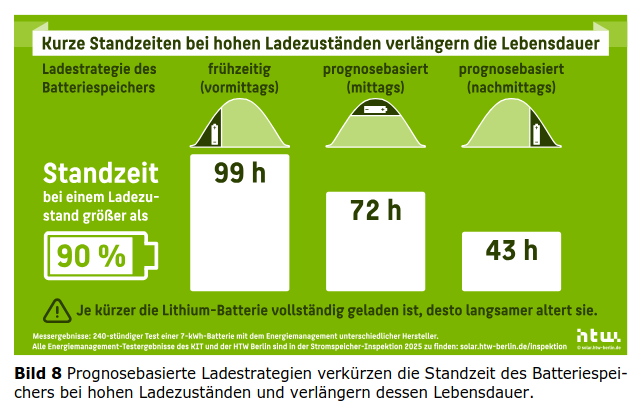
Kuva 8
Mitä tarkoitetaan graafin kuvatekstillä "Forecast-based charging strategies shorten the service life of the battery storage system at high charging states and extend its service life." (kone käännös Saksasta)
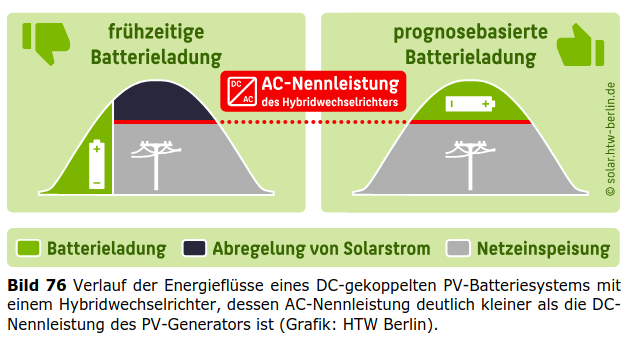
Kuva 76
illustrates the influence of the battery charging strategy on the energy flows on a sunny summer day when the hybrid inverter is undersized compared to the is undersized compared to the PV generator. If the battery charges without without forecast-based energy management as soon as surpluses occur, it is fully fully charged during the morning. At lunchtime, the AC rated power of the hybrid inverter limits the power output of the PV generator. If, on the other hand, with the help of forecast-based energy management sufficient storage capacity is kept free for charging at midday, the curtailment losses can be minimised. For this purpose, the battery storage system absorbs otherwise unused PV power peaks above the AC rated power of the hybrid inverter. With the now common practice of overloading of hybrid inverters, which is now common practice, a forecast-based energy ultimately increases the electricity yield of the PV system and the energy fed into the grid, which is advantageous for the operators.
Saksalaiset ovat jälleen testailleet eri akkuja.
ELECTRICITY STORAGE INSPECTION 2025
Muutama poiminta sieltä, hyötysuhde 100W kuormalla.
Näytä liitetiedosto 104863Näytä liitetiedosto 104865
Näytä liitetiedosto 104864Näytä liitetiedosto 104866
Die Studie bewertet erstmals das Energiemanagement von sechs Heimspeichersystemen und bestätigt zwei neue Wirkungsgradrekorde.

solar.htw-berlin.de
Hyötysihde 1% kuormituksella lienee haastavaa. Yksitäisenä lukuna hyödytön mutta alleviivaa ongelmaa... akkuinverteri täytyy mitoittaa optimialueelle siinä missä kaikki muukin. Kyseessä lienee DC-AC muunoksen tehokuudesta eikä kokonaishyötysuhteesta. Ja täsät muituukin mielee aikaisemmat hyöttysuhteet joidenka hyvyyttä hieman kummastelin. Jotta paremmuss olisi helpompi todentaa niin hyötysuhde varmaan pitäisi laskea esim 30 tai 50% kuormituksella nimellistehosta.






 No jopas nyt, ei varmaan puhuta kuitenkaan kesästä niin ei kyllä 30kWh viikkoa pyristellä.